- Does this tooth hurt on its own?
- Are you taking anything for tooth pain?
- Is this tooth waking you up at night or keeping you from sleeping?
- Do you have any swelling?
Tuesday, June 23, 2026
The Core 4: Endodontic Triage for Smarter Scheduling
Monday, January 26, 2026
Fractured Logic: The Danger of Diagnosing Before Diagnosing
Proper diagnosis is so crucial to treatment planning. A necrotic pulp with an enormous, alveolar bony defect - even with lateral bone loss - is not indicative of root fracture. It is a possibility, but if the tooth has never had RCT before - I do not assume a root fracture. EVEN if the bone loss is extensive. Here's a great example. 6 months healing on a tooth that could easily be considered non-restorable.
| #30 was first seen in 2021 and no tx recommended. |
| Pt returns in July 2025 with necrotic #30 and large apical lucency |
| CBCT shows a floating distal root. This would be easy to assume the root is fractured and not treatable OR that perio status would be poor... |
| RCT completed July 2025 |
| 6 Month Recall!!!! |
| Check out that furcal bone healing! |
| Check out that distal bone healing. No root fracture or perio issues. |
Sunday, June 29, 2025
Xela-Aid - Local Hope Guatemala Needs Your Help!
Having traveled multiple times to do dental work in Guatemala, we recently had the opportunity to visit San Martin Chiquito, in the highlands of Guatemala to do some volunteer work in the Xela-Aid dental clinic. Our previous two visits to Guatemala were with the Open Wide Foundation through the Spear organization, however, following COVID, the Open Wide clinics were no longer functioning, so we were excited to learn about Xela-Aid and their clinic in a small Mayan village near Queztaltenango, Guatemala. The word Xela (pronounced "SHAY-lah") is a shortened form of the ancient Mayan name Xelajú which means “under the ten mountains” in the Kʼicheʼ Maya language. Today, both locals and visitors commonly refer to Quetzaltenango as Xela. The name reflects the city's strong indigenous heritage and its cultural significance in the Guatemalan highlands.
Xela‑AID (also known as Local Hope Guatemala) is a U.S.-based 501(c)(3) nonprofit dedicated to empowering underserved families in the Guatemalan Highlands. In the rural highlands of Guatemala, access to healthcare—especially dental care—is limited. That’s where Xela-AID steps in. Founded in 1992, Xela-AID's mission is to support underserved families in becoming healthy, educated, and self-reliant.| Xela-AID clinic (yellow), Montessori School & EcoLodge (white) |
What makes Xela-AID unique is its long-term, community-based model. Rather than offering temporary relief, the organization builds partnerships and infrastructure to promote lasting change. From scholarships and literacy programs to sanitation systems and medical care, Xela-AID offers comprehensive support to families in San Martín Chiquito and surrounding villages.
For healthcare professionals, especially those in the fields of medicine, optometry, mental health, and dentistry, there are specific opportunities to serve in the organization’s medical clinic. Volunteers help deliver essential services, train local staff, and expand the clinic’s reach and impact.
Xela-AID offers a range of volunteer opportunities—both on-site in Guatemala and remotely from home. Volunteers participate in education programs, construction projects, and health initiatives. Xela-AID provides organized volunteer trips with unique, local experiences as well as customized opportunities to serve what may work best with your schedule.
| Dr. Jason Hales in the dental clinic |
Xela-AID’s clinic offers weekly dental services, thanks to a mix of visiting and local providers. Services include exams, cleanings, fillings, and extractions. Equally important is the preventive work: volunteers help educate children and families on basic oral hygiene and distribute toothbrushes, toothpaste, and soap as part of the organization’s hygiene and health education program.
Dental professionals who volunteer with Xela-AID have the opportunity to provide treatment, introduce new techniques, support preventive education, and mentor staff. It’s a direct way to address an urgent need while building local capacity for ongoing care.
One of the most distinctive features of Xela-AID’s approach is how seamlessly it integrates healthcare, education, and community engagement in a single location.
| Volunteers at the Montessori School |
This school gives local children access to high-quality early learning—something rare in rural Guatemala. It also allows parents, many of whom are receiving care or participating in Xela-AID’s training programs, to bring their children to a safe and nurturing environment each day.
To support its growing network of volunteers and visitors, Xela-AID has also developed comfortable on-site housing. Whether you’re a healthcare professional traveling to staff the clinic, a teacher volunteering in the school, or a donor coming to see the impact firsthand, Xela-AID’s lodging provides a welcoming home base.
![]() |
| Dr. Paul Kelly visiting the Co-Op store |
One of the most unique features is the Eco-Lodge, located on the third floor of the school building. This thoughtfully designed space offers private accommodations and sweeping views of the surrounding mountains and farmland. More than just a place to sleep, the Eco-Lodge provides a rare opportunity to live in the heart of a working Mayan community—sharing meals, walking the same paths, and engaging with neighbors as part of daily life. All meals can be provided on-site and prepared by local women using authentic Mayan recipes and ingredients. Meals are healthy, flavorful, and thoughtfully made, offering guests a chance to experience the local culture through its cuisine.
Guests often describe their stay at the Eco-Lodge as one of the most meaningful aspects of their service trip. It’s not just immersive—it’s deeply grounding and reflective of Xela-AID’s model: working with, not just for, the communities they serve.
| Dr. Morris Oswald |
Opportunities for meaningful service abound at Xela-AID. Whether your background is in healthcare, education, construction, or community outreach, your time and talents can make a lasting difference. One of the areas of greatest ongoing need is the dental clinic, where volunteers—especially dentists, hygienists, and dental assistants—can provide critical care that is otherwise unavailable in the region. Even a short trip can have a profound impact on the oral health and well-being of the local population.
To learn more about how you can get involved, visit xelaaid.org, or for more information about dental trips contact Dr. Michael Johnson, who can help guide you through the volunteer process. For those unable to travel, Xela-AID also welcomes support through fundraising, administrative help, and program sponsorships.
| Market at San Juan Ostuncalco |
Tuesday, April 1, 2025
Clinical Steps for Vital Pulp Therapy
The Evolution of Vital Pulp Therapy: A Paradigm Shift in Carious Lesion Treatment
Our previous post introduced the benefits of modern bioceramic materials and their transformative impact on the treatment of carious lesions in teeth with vital pulpal tissue. Traditional methods such as indirect pulp capping, direct pulp capping, or SVEC pulpotomies using calcium hydroxide Ca(OH)2 are now being replaced by a more advanced procedure known as Vital Pulp Therapy (VPT) utilizing modern bioceramic materials. (AAE Position Statement on Vital Pulp Therapy)
The Role of Modern Bioceramic Materials in Vital Pulp Therapy
The foundation of Vital Pulp Therapy lies in the biocompatible and bioactive properties of modern bioceramic materials. No longer do we need to be concerned about the potential for dental materials to damage the pulp or the risk of pulpal exposure during carious excavation. Instead, the focus has shifted to complete caries removal, even if it necessitates partial or complete pulpotomy, followed by immediate placement of a bonded, permanent restoration.
A 2011 systematic review (Aguilar, Panuroot et al.) on cariously exposed vital pulps treated with DPT (direct pulp capping) showed a 72.9% success rate at 36 months compared to 99.4% and 99.3% success on teeth treated with partial and full pulpotomy at the same 36 months.
Furthermore, a 2021 meta-analysis (Sabeti et al.) examining the prognosis of VPT in permanent teeth found that when MTA or other bioceramics were used as a capping material, success rates reached 93%.
These findings highlight that VPT should be strongly considered over traditional direct or indirect pulp capping and as a viable treatment option for carious teeth—except in cases where endodontic therapy is required to due pulpal necrosis or for restorative purposes, such as post placement.
Expanding Indications for Vital Pulp Therapy - IRREVERSIBLY INFLAMMED TEETH
Initially, it was believed that VPT would be limited to teeth with normal or reversible pulpitis. However, emerging evidence suggests that this approach may also be effective for teeth with irreversible pulpitis. A recent 2024 randomized cohort study (Zhang et al.) evaluating VPT using bioceramic materials in cariously exposed pulps with both reversible and irreversible pulpitis found a one-year clinical success rate of 90.4%.
A randomized controlled trial (Jassal et. al.) found that the success rates of vital pulp therapy (with a bioceramic) between partial and full pulpotomies on teeth with irreversibly inflamed pulps was statistically insignificant. They reports 88% success rate for partial pulpotomy and 91.6% success rate for full pulpotomy at 1 year.
Another systematic review (Cushley et.al.) of permanent carious molars with irreversible pulpitis treated with coronal pulpotomy found a 94% clinical success rate and 88% radiographic success rate at 36 months.
This research underscores the potential for VPT to serve as a conservative treatment option for your patients before the need for endodontic intervention arises. This data would suggest that you can consider treating permanent, cariously exposed teeth with NORMAL, REVERSIBLE and IRREVERSIBLE pulpitis with more conservative vital pulp therapy before you move to full endodontic therapy.
At SSE, our goal is to support your restorative practice by informing you of conservative treatment options you may consider before referring patients for endodontic therapy at Superstition Springs Endodontics. This treatment is best performed in your office where you can immediately restore your patient with a permanent restoration.
Determining Candidacy for Vital Pulp Therapy
For successful VPT implementation, consider the following criteria:
Vital Pulp Therapy IS an option if:
The pulp is vital and responds to thermal testing. (Irreversibly inflamed pulps are also in this category)
The patient understands that a root canal may still be required if the pulp is too inflamed upon access or necroses over time. (Set realistic expectations.)
The tooth has immature roots that still require apical closure.
Vital Pulp Therapy IS NOT an option if:
The pulp is necrotic (evidenced by swelling, sinus tract, or periapical lesion).
Decay is so extensive that root canal therapy is required for restorative purposes (e.g., the need for post placement or extensive decay preventing proper restoration).
Factors That May Improve VPT Success:
Asymptomatic patients
Younger patients
Larger canals/apices
Step-by-Step Guide to Performing Vital Pulp Therapy
Pulpal Diagnosis & Informed Consent – Confirm a vital pulp through diagnostic testing and ensure the patient understands that endodontic therapy may still be necessary.
Rubber Dam Isolation – Maintain a dry, sterile field.
Complete Caries Excavation – Remove all carious tissue, even if pulpal exposure occurs.
Hemostasis Control – Apply direct pressure with a cotton pellet to control bleeding. If bleeding persists beyond 3-4 minutes, remove additional pulpal tissue. If necessary, perform a full pulpotomy. If hemostasis cannot be achieved, consider endodontic therapy.
Application of Bioceramic Material – Once bleeding has stopped, apply a bioceramic material directly onto the pulpal tissue.
Protective Base Placement – Place a glass ionomer base over the bioceramic to prevent washout during bonding of the final restoration.
Final Restoration – Place a permanent bonded restoration.
Coronal Coverage – Consider full coronal coverage if the tooth requires additional reinforcement.
Follow-Up & Monitoring – Conduct periodic evaluations to assess pulpal health and radiographic changes.
Conclusion
Vital Pulp Therapy represents a significant advancement in conservative dental care, providing an effective alternative to traditional pulp capping techniques and, in some cases, even root canal therapy. By integrating modern bioceramic materials into your practice, you can offer patients a more conservative, biologically favorable approach to managing carious lesions while preserving pulpal vitality.
At SSE, we are committed to supporting your practice with the latest advancements in restorative and endodontic treatment options. If you have questions or need guidance on incorporating VPT into your workflow, we’re here to help!
Consider the following case examples.
![]() |
| Deep decay on a vital pulp of young patient |
![]() |
| Complete caries removal, hemostasis achieved, MTA bioceramic placed on exposed pulp |
![]() |
| Immediate, bonded restoration placed |
![]() |
| VPT Final |
![]() |
| Deep decay on a young patient with vital pulp |
![]() |
| Rubber Dam isolation and caries excavation |
![]() |
| Pulp exposed, complete caries removed and hemostasis of the remain pulp achieved with pressure |
![]() |
| Bioceramic putty placed against the exposed pulpal tissue & glass ionomer base placed over the bioceramic |
![]() |
| Bonded restoration placed |
![]() |
| VPT completed with partial pulpotomy |
![]() |
| VPT with complete removal of pulpal tissue in the pulp chamber (pulpotomy) |
![]() |
| VPT completed with partial pulpotomy |
SOURCES:
1. AAE Position Statement on Vital Pulp Therapy, Journal of Endodontics, Sept 2021, Vol 47, No 9, p1340-1344.
2. Vital Pulp Therapy in Vital Permanent Teeth with Cariously Exposed Pulp: A Systematic Review. Aguilar, Panuroot et al. Journal of Endodontics, Volume 37, Issue 5, 581 - 587.
3. Prognosis of Vital Pulp Therapy on Permanent Dentition: A Systematic Review and Meta-analysis of Randomized Controlled Trials. Sabeti, Mohammad et al. Journal of Endodontics, Volume 47, Issue 11, 1683 - 1695.
4. Clinical Influencing Factors of Vital Pulp Therapy on Pulpitis Permanent Teeth with 2 Calcium-Silicate Based Materials: A Randomized Clinical Trial. Zhang, Yin, Wu, Wang, Huang, Li. Medicine (Baltimore) 2024. May 3: 108(18).
5. Outcome of partial and full pulpotomy in cariously exposed mature molars with symptoms indicative of irreversible pulpitis: A randomized controlled trial. Jassal A, Nawal RR, Yadav S, Talwar S, Yadav S, Duncan HF. , Int Endod J. 2023 Mar;56(3):331-344. doi: 10.1111/iej.13872. Epub 2022 Dec 4. PMID: 36403208.
6. Pulpotomy for mature carious teeth with symptoms of irreversible pulpitis: A systematic review. Cushley S, Duncan HF, Lappin MJ, Tomson PL, Lundy FT, Cooper P, Clarke M, El Karim IA. , J Dent. 2019 Sep;88:103158. doi: 10.1016/j.jdent.2019.06.005. Epub 2019 Jun 20. PMID: 31229496.
Thursday, February 6, 2025
Modern Bioceramics in Endodontics
Porcelains have been at the heart of esthetic dentistry since the 1960's with a broad assumption that they are bioinert - not eliciting a reaction from the tissues around them.
Without diving too deep in the science of biomaterials, a bioactive material is one that intentionally elicits a response from adjacent tissues and biocompatability refers to a material that does not cause harm to adjacent tissues. Biocompatibility is not absolute(1) and requires evaluation of a material's interaction with tissues over time. In other words, more complex than this discussion.
Advances in dental ceramics have continued to evolve into what we now call bioceramics. These materials include hydroxyapetitie, bioactive glass and calcium silicates.(2)
One of the earliest bioceramics used in Endodontics was Mineral Trioxide Aggregate - a silicate cement. This bioactive and biocompatible material was unlike anything we had seen before in endodontics. It could be used in a moist environment - actually requiring moisture to set up, did not seem to irritate the adjacent tissues and bone would form right up against it! It did not take long for this material to be used for root repair (additional example) & apicoectomy retrofills.
With the biocompatible success of this material, and seeing that it clinically created good seal, it wasn't long before we began using this bioceramic for direct pulp capping and using this material to replace traditional apexification/apexogenesis a new type of procedures known as pulpal regeneration.
One of the biggest challenges with the use of MTA was the grey discoloration of the tooth. The grey staining of the tooth created esthetic challenges in the anterior. In effort to address this complication, Tulsa Dentsply developed a white MTA by reducing the aluminoferrite content.
The bioceramic line up has grown since the development of white MTA with additional calcium silicate cement products from Septodont, Brasseler, Avalon Biomed etc. These modern bioceramic materials claim to have the impressive properties of:
- Osteogenicity
- Chemically bond to dentin
- Antibacterial (pH>12)
- Hydrophilic
- Hydroxyapatite producing
- No shrinkage
- Good working/setting time
- Easy delivery systems
Sources:
1. Wataha JC. Principles of biocompatibility for dental practitioners. J Prosthet Dent. 2001 Aug;86(2):203-9. doi: 10.1067/mpr.2001.117056. PMID: 11514810.
2. Dong X, Xu, X. Bioceramics in Endodontics, Updates and Future Perspectives. Bioengineering. 2023 Mar13;10(3):354.
3. Prognosis of Vital Pulp Therapy on Permanent Dentition: A Systematic Review and Meta-analysis of Randomized Controlled Trials Sabeti, Mohammad et al. Journal of Endodontics, Volume 47, Issue 11, 1683 - 1695
Wednesday, March 15, 2023
Wednesday, September 7, 2022
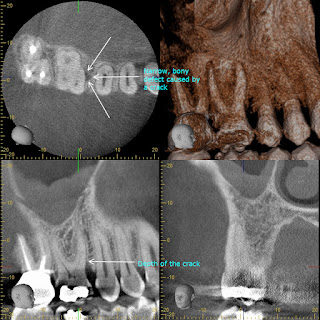
Using CBCT to Diagnose the Depth of a Cracked Tooth
One of the many uses of CBCT is to help us determine the depth of a crack - seen on the occlusal surface of a tooth, but uncertain as to how deep it goes down the root. Obviously the deeper the crack goes below the CEJ, the poorer the long term prognosis.
This patient was mostly asymptomatic until he recently bit into something and has had pain ever since.
Friday, March 4, 2022
Innovations in the Dental Insurance World
|
|
|
Monday, November 1, 2021
Survival in the Dental Office: Brain Based Leadership Concepts to Help your Practice
|
Monday, April 26, 2021
Dealing with Cracked and Fractured Teeth - An Inner Space Seminar
At a recent Inner Space Seminar, Dr. Jason J. Hales discussed dealing with cracked and fractured teeth.


